






I. Introduction
As the power core of industrial-grade drones, electronic speed controllers (ESCs) are critical to operational safety and efficiency. To extend their lifespan in complex application scenarios, standard maintenance and meticulous management are essential. The following outlines ESC maintenance and operational protocols, drawing upon industry standards and practical experience.
II. Technical Specifications for Routine Maintenance and Servicing
- Maintenance every 10 operating hours: Use high-pressure air to blow-clean the heat sinks and terminal blocks, removing dust, oil residues and fibrous contaminants. Do not use liquid cleaners to prevent short circuits.
- Maintenance every 20 operating hours: Power on and inspect the cooling fan's rotational speed. Should any abnormal noise, irregular speed, or cessation of rotation be detected, disassemble according to the manufacturer's instructions. Clean accumulated dust from fan blades and bearings using a soft-bristled brush. Apply one-third of the bearing volume with high-temperature resistant lithium-based grease to ensure proper fan operation.
2.2 Status Check: Identifying Potential Fault Risks
- Terminal blocks: Tighten screws to manufacturer's specifications using a torque wrench. Inspect terminals for oxidation or burn damage.
- Insulation Layer Inspect power cables and signal lines, paying particular attention to connectors and bends. Should insulation damage occur, repair using appropriately sized heat-shrink tubing. Heat to 120–150°C, ensuring no bubbles or gaps remain.
- Capacitors / Resistors Visual inspection combined with multimeter testing: Capacitors must show no bulging (top protrusion >1mm) or leakage; resistors must show no scorching or discolouration. Solder joints must be free from cold solder joints or detachment. Replace with identical model components if abnormalities are detected.
- Heat dissipation structureCheck the thermal interface material application on the heat sink. Where gaps exceed 0.1mm, reapply thermal grease to ensure adequate heat dissipation.
- Storage environmentStore in a dry environment at a suitable temperature, away from corrosive gases and strong magnetic fields. It is recommended to use a temperature and humidity recorder, exporting data monthly for archiving.
- Transportation ProtectionWrap in anti-static packaging, securing fragile components with foam padding; avoid violent shaking and prohibit stacking with excessively heavy items.
- Standard calibration: Employ the flight controller's dedicated calibration tool to calibrate ESC and flight controller signals, ensuring linear throttle response accuracy.
- Calibration after replacementAfter replacing the motor or ESC, the following steps must be completed: ① Calibrate the throttle travel and set the ESC throttle signal value to match the flight controller; ② Conduct a no-load power-on test to verify the motor rotation direction aligns with propeller requirements. If reversed, adjust the motor wiring phase.
III. Key Considerations for Operational Functioning
- Parameter Matching: Ensure the ESC's rated parameters are compatible with the power system; over-specification is strictly prohibited. Requirements: ① ESC rated current ≥ maximum operating current of the motor; ② ESC input voltage range must cover the battery voltage.
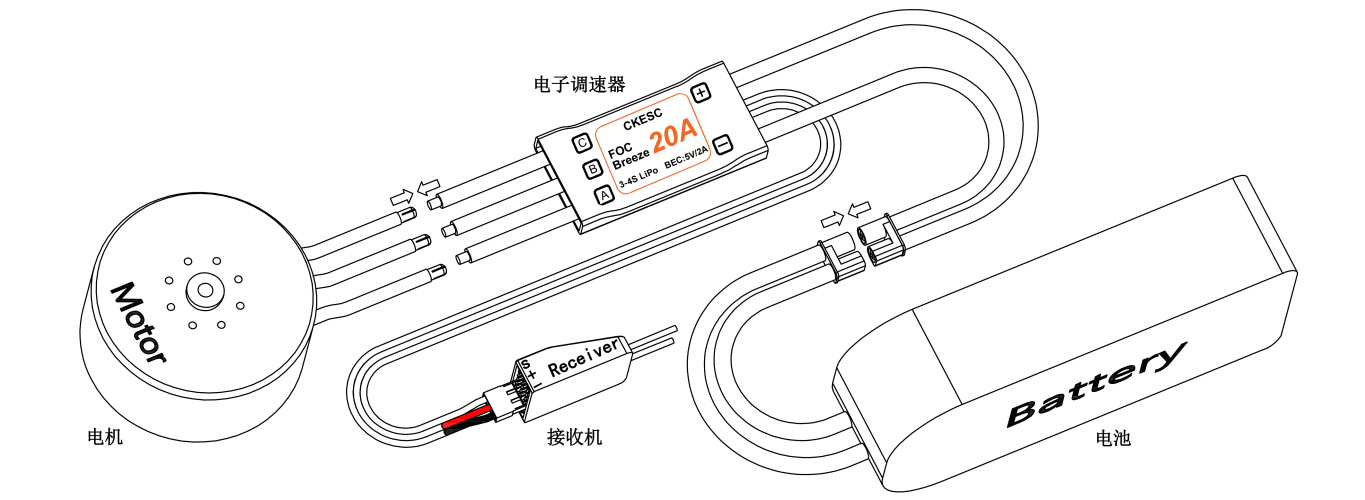
- Pre-inspection: ① Verify wiring polarity, ensuring power cables (red positive, black negative) and signal cables (e.g., PWM lines) are securely fastened without slack; ② Clear any obstructions around the heat sink and fan.
- Environmental Adaptation : At elevated temperatures, activate cooling fans 10-15 minutes in advance; at low temperatures, first connect to battery power in idle mode for 5 minutes of preheating, then initiate motor operation once the ESC surface temperature reaches ≥5°C.
3.2 Operational Monitoring: Real-time Status Control
During operations, a mechanism comprising ‘data monitoring – anomaly handling – load control’ must be established to prevent damage from overload:
- Real-time Monitoring: Record critical data via the flight controller data link. Key monitoring points: ① ESC surface temperature; ② Operating current ≤ rated value; ③ Voltage fluctuation (deviation from battery nominal voltage).
- Abnormal Condition Handling: Should abnormal motor noises, airframe vibrations, or sudden ESC temperature spikes occur, immediately reduce load and investigate; if the issue cannot be resolved, perform an emergency landing to prevent ESC burnout.
- Load Control: Restricts full throttle operation to reduce current surges. Prolonged heavy loads require shutdown for cooling, maintaining fan operation throughout.
3.3 Emergency Response: Standardising Fault Handling Procedures data-string=‘true’ data-enter=‘true’ data-leaf=‘true’>For common protection mechanism triggers and abnormal conditions in electronic speed controllers, the following procedures must be followed:
- Over-temperature protection: When the electronic speed controller triggers over-temperature protection (power reduction), measure the surface temperature using an infrared thermometer. Allow the unit to cool to below 60°C before restarting. Prior to restarting, inspect the cooling fan and clear any accumulated dust from the heat sink to eliminate potential heat dissipation issues.
- Overcurrent protectionFlight controller displays ‘ESC Overcurrent’ alarm. Power off and inspect for motor jamming or foreign objects entangled in propellers. After troubleshooting, conduct no-load testing. Resume operation only when current readings return to normal.
- Power Disconnection Protocol: Upon completion of operations, first switch off the power supply switch (if present) and allow residual capacitor charge to dissipate. Subsequently disconnect the battery connection. Never disconnect the battery directly to prevent reverse current surging into the circuit.
3.4 Special Scenario Requirements: Adaptation to Complex Environments
- For special scenarios such as outdoor use, high-altitude operations, and post-maintenance conditions, enhanced control measures are required:Outdoor operations: Prevent the ESC from being exposed to rainwater or dust. For water-related tasks such as aquatic inspections, additionally fit an IP67 or higher waterproof enclosure. data-leaf=‘true’>IP67 or higher waterproof cover. Remove promptly after operation and use high-pressure airflow to clear residual moisture and dust.
- High-altitude environments: Thinner air reduces heat dissipation efficiency, necessitating load reduction.
- Post-Repair Operation: Following ESC repair, conduct an initial no-load test to monitor speed fluctuations and no-load current. Upon confirming no abnormalities, operate under light load at ≤30% rated capacity for 30 minutes. Only resume normal operation if no faults occur.